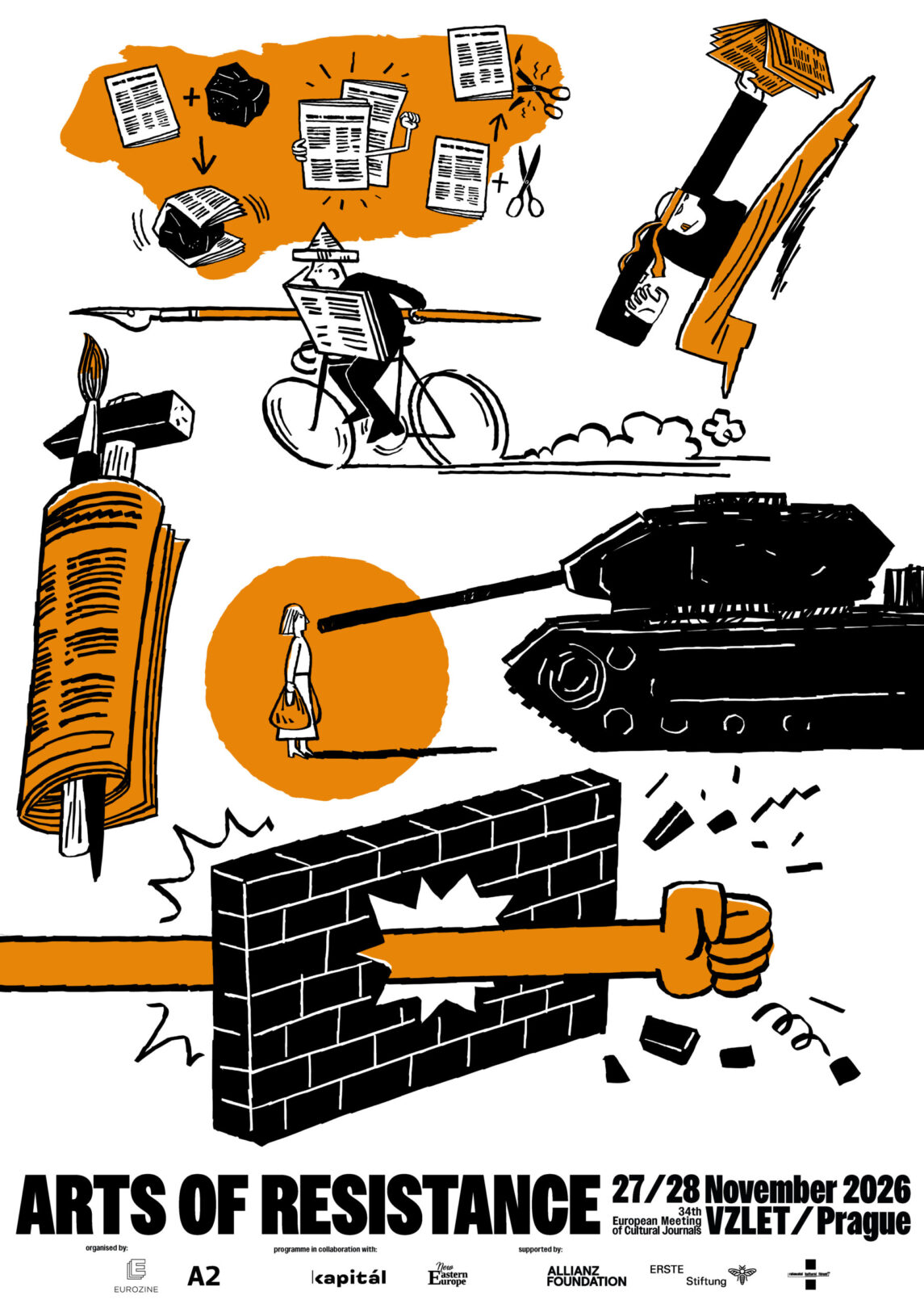
Arts of Resistance. 34th European Meeting of Cultural Journals
Interantional Conference Organized by Eurozine & A2
Independent culture is increasingly the target of nationalist populist forces across Europe. In Czechia, where the far right is in government, the cultural sector is facing a state-led assault on its means of existence; in Slovakia, where cultural organizations are struggling against defunding and institutional capture, the situation is worse still.
Elsewhere in central and eastern Europe, independent cultural practitioners have experience of similar if not more extreme forms of political adversity: be it the massive state repression of civil society, or the attempt at national-cultural annihilation from a neighbouring aggressor.
Building on traditions of dissidence, but also developing new responses to fundamentally different situations, independent culture is resisting in various ways. How can solidarity between cultural practitioners, activists and experts across disciplines lead to a more cohesive approach to resistance? In particular, can independent culture find common ground with environmentalism in resisting retrograde corporate and political decision-making?
How does the political adversity confronting independent culture across Europe vary in form and intensity? What practices and expressions of culture are threatened where? What strategies have evolved for resisting?
At the 34th European Meeting of Cultural Journals in Prague, theorists, practitioners, writers and editors will meet to discuss these and other questions, together developing responses to different though comparable sets of challenges.
Programme
FRIDAY 27 NOV
18:00–19:30 KEYNOTE SPEECH
Ivan Kalmar – The agony of being Central European, and how to resist it
What can Central Europeans learn from those in countries and regions that are also not great powers, but whose cultural production travels the world more successfully, such as Scandinavia or South Korea?
SATURDAY 28 NOV
14:00–15:30 PANEL – Independent culture and traditions of resistance in Central Europe
Central and eastern Europe’s traditions of dissidence have become politically ambiguous. How are concepts of culture and resistance associated with dissident movements seen by those active in independent culture today? Can dissident traditions be drawn upon or revived? Or are fundamentally different strategies required
Panellists: Pavel Barša, Dominik Želinský, Agata Pyzik
Moderator: Julia Sherwood
15:35–16:00 CONVERSATION – Culture at the extremes: Ukraine
Marìčka Paplauskajte (Reporters / Ukrainians Media) and Adam Reichardt (New Eastern Europe)
16:30–17:45 PANEL – Culture and environment: A common struggle?
Critically engaged culture and eco-politics are increasingly being labelled as imposed ideologies within nationalist culture wars. Could the cultural sphere, already described as an interconnected ecosystem, find a strong counterposition alongside political ecology, ecocriticism and decolonial humanities? How could efforts to defend the environment and culture effectively unite?
Panellists: Anežka Bartlová, Julia Fiedorczuk, Iryna Zamuruieva
Moderator: Olav Fumarola Unsgaard
17:50–18:15 CONVERSATION – Culture at the extremes: Georgia
Nata Dzvelishvili (Indigo) and Tomaš Hučko (Kapitál)
18:25–19:00 CONVERSATION – Listening as resistance
Miriam Rasch and Sarah Waring
Organized by: Eurozine & A2
Programme in collaboration with: Kapitál & New Eastern Europe
Supported by: